Around 1 in 7 people get migraine. In the UK, that's roughly 10 million people.1 An attack usually lasts somewhere between 4 hours and 3 days, and some people get them several times a week.2
But not all migraines are the same. There are several types, each with its own pattern of symptoms. Some cause weakness down one side of the body. Others bring on dizziness, tummy pain or no headache at all.
This guide walks you through the stages of a migraine attack, the main types of migraine and how each one is managed. That way, you'll know what you're dealing with and when it's time to get checked.
Knowing which type of migraine you get matters, because some treatments that suit one type aren't recommended for another.
What are the stages of a migraine attack?
Most migraine attacks move through up to four stages: prodrome, aura, headache and postdrome. Not everyone gets every stage. They can also overlap, or change from one attack to the next.3
Prodrome
The prodrome is the early warning stage. It can start hours, or even up to 2 days, before the head pain kicks in.2
The signs are often subtle. You might feel very tired and keep yawning, crave sweet foods, feel thirsty or need to pee more. Some people get a stiff neck, feel low or irritable, or find it hard to concentrate.3
Learning your own early warning signs gives you a head start, since painkillers tend to work best when you take them as the headache begins.
Aura
Up to a third of people with migraine get aura.3 These are temporary symptoms from your nervous system. They usually build up gradually and last 5 to 60 minutes.
Changes to your sight are by far the most common. In one study of 227 adults with migraine with aura, 94.7% had visual symptoms.4 Typical examples include:
- zigzag lines
- flashing or flickering lights
- coloured spots
- blind spots
Aura can also cause numbness or pins and needles, problems speaking, ringing in your ears or dizziness.3 In that same study, around a third of people had more than one type of aura.4
Headache
This is the main event. The pain is usually moderate to severe and throbbing, and it gets worse when you move. It often starts on one side of your head but can spread to both sides.3
It usually comes with feeling or being sick, plus sensitivity to light, sound and smells. That's why so many people head for a dark, quiet room.
Postdrome
Once the headache fades, you might feel drained or like you have a hangover. Tiredness, brain fog and mood changes are common. It can take hours or even days to feel like yourself again.3
What are the most common types of migraine?
Migraine is grouped into types based on your symptoms and how often attacks happen. These are the types most people are diagnosed with, and plenty of people have more than one.
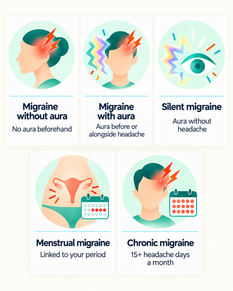
Migraine without aura
This is the most common type of migraine. You get the headache stage, often with nausea and sensitivity to light and sound, but no aura beforehand.
Common triggers include stress, tiredness, skipping meals, too much caffeine and, for some women, their period.2 Our guide to avoiding migraine triggers has tips on spotting yours.
Migraine with aura
Here, aura symptoms come before or alongside the headache. Aura usually comes first. But for around 1 in 5 people, it can start after the headache has already begun.4
Many people with migraine with aura also have attacks without it.3
Silent migraine (migraine aura without headache)
A silent migraine means you get aura symptoms, like flashing lights or zigzags, but no headache follows.3
It's fairly common. In the study above, about a third of people with migraine with aura had at least some aura episodes with no headache at all.4
No pain doesn't mean no disruption, though. Visual disturbances still make it hard to work, read or drive safely.
A silent migraine still counts as migraine, so it's worth raising with a GP even if head pain never follows.
Menstrual migraine
Menstrual migraine attacks are linked to your period. They tend to happen from around 2 days before your period starts up to the third day of bleeding.5
It's very common. As many as two-thirds of women with migraine may have attacks linked to their periods. But "pure" menstrual migraine, where attacks only happen around your period, affects fewer than 1 in 100 women with migraine.5
Period-related attacks are often longer and more severe than attacks at other times.2 The likely culprit is the natural drop in oestrogen in the days before your period.5
Combined hormonal contraception (the combined pill, patch or ring) can help some people by smoothing out that drop.5
Combined hormonal contraception is not suitable if you get migraine with aura, so always mention any aura symptoms to whoever prescribes your contraception.
Chronic migraine
Chronic migraine means having a headache on at least 15 days a month for 3 months or more, with migraine symptoms on at least 8 of those days.1 Fewer headache days than that is called episodic migraine.
Frequent painkiller use can make things worse. This is known as medication overuse headache, and the NHS advises trying not to take painkillers on more than 2 days a week.2
What are the less common types of migraine?
These types are rarer, and several can look like other conditions. They usually need a proper diagnosis from a GP or specialist.
Ocular migraine and retinal migraine
"Ocular migraine" is one of the most searched migraine terms, but it isn't a formal diagnosis. People often use it to describe visual aura, which comes from the brain rather than the eye itself.
Retinal migraine is different. It causes repeated, fully reversible disturbances in one eye only, such as flickering, blind spots or temporary loss of sight. These usually last 5 to 60 minutes and come with, or are followed by, a headache.6
True retinal migraine is extremely rare. Other causes of temporary sight loss in one eye have to be ruled out first. Some people who think only one eye is affected actually have a disturbance on one side of their vision in both eyes.6
Losing your sight, even briefly, needs urgent medical attention. Do not assume it's an ocular migraine until other causes have been ruled out.
Hemiplegic migraine
Hemiplegic migraine is rare. It causes temporary weakness on one side of your body as part of the attack. This often comes with aura symptoms like changes to your vision, slurred speech or confusion.7
Because the symptoms look so much like a stroke, it can be very frightening. The weakness usually goes within 24 hours, but it can last anywhere from an hour to several days. The headache may come before the weakness, after it or not at all.7
There are two forms. Familial hemiplegic migraine runs in families and is linked to changes in genes including CACNA1A, ATP1A2 and SCN1A. On average, half of children with an affected parent develop it. Sporadic hemiplegic migraine has the same symptoms but no known family link.7
Triptans aren't licensed for hemiplegic migraine.8 They're best avoided during the aura phase, and a specialist should decide whether they're safe to use later in the attack.7
Do not take a triptan for a hemiplegic migraine unless a specialist has confirmed it is safe for you.
Vestibular migraine
Vestibular migraine mainly affects your balance. Vertigo (a spinning or swaying feeling), dizziness and unsteadiness are often the main symptoms, rather than head pain.9
Episodes can last anywhere from 5 minutes to 72 hours. To be diagnosed, you need to have had migraine at some point. At least half of your dizzy episodes also need to come with migraine features, such as headache, sensitivity to light and sound, or visual aura.10
Not every vestibular migraine episode brings a headache, so dizzy spells on their own can still be part of the same condition.
Other inner ear conditions can cause similar symptoms and need to be ruled out.10 That's why you may be referred to an ear, nose and throat (ENT) specialist.
Abdominal migraine
Abdominal migraine mainly affects children. Around 4 in 100 children get it, along with some adults.9
Instead of head pain, it causes repeated attacks of moderate to severe tummy pain, usually around the belly button. Attacks often come with loss of appetite, nausea, vomiting or looking pale, and last 2 to 72 hours. In between, children are completely well.11
Other causes of tummy pain need to be ruled out before abdominal migraine is diagnosed. Most children with abdominal migraine go on to develop migraine headaches later in life.11
How is each type of migraine treated?
Migraine can't be cured, but treatment can ease attacks and help prevent them. What works depends on how severe your migraine is and how often attacks happen. Many people need to try a few options before finding the right fit.2
For what to take during an attack, from painkillers and anti-sickness medicine to triptans, see our complete guide to migraine. You can also compare the migraine treatments available through our online consultation.
If your attacks are frequent or hard to control, a GP may suggest preventive treatment. Options include some blood pressure, antidepressant and epilepsy medicines, as well as acupuncture, relaxation techniques, cognitive behavioural therapy (CBT) and vitamin B2 (riboflavin).2
Daily habits matter too. The NHS recommends eating at regular times, staying hydrated, limiting caffeine and alcohol, exercising regularly, getting plenty of sleep and finding ways to manage stress.2
Keeping a migraine diary helps you spot patterns and triggers.2 It also gives your GP useful detail if you need a diagnosis.
Prevention rarely comes down to one thing. Steady routines and a well-kept diary give you and your GP far more to work with.
When should you get medical advice?
See a GP if:
- your attacks are severe, getting worse or lasting longer than usual
- you get attacks more than once a week
- you're finding it hard to control your migraine
- you regularly get migraine before or during your period
Ask for an urgent GP appointment or contact NHS 111 if an attack has lasted longer than 72 hours, aura lasts longer than an hour, or you're pregnant or have just had a baby.2
Call 999 if you:
- get a sudden, extremely painful headache
- lose your vision, or have blurred or double vision
- have weakness in an arm, a leg or one side of your face
- have problems speaking or remembering things
- feel drowsy or confused, or have a seizure
- have a very high temperature and symptoms of meningitis
- have recently had a head injury
Some migraine types can look exactly like a stroke. If one-sided weakness or speech problems are new to you, treat them as an emergency until a doctor says otherwise.
Frequently asked questions
How long does a migraine last?
Most migraine attacks last between 4 hours and 3 days. That covers the headache itself, but early warning signs can start hours or even a couple of days before, and you may feel drained for a while afterwards. Aura, if you get it, usually lasts no longer than an hour. If an attack goes on for longer than 72 hours, ask for an urgent GP appointment or contact NHS 111.
What causes an ocular migraine?
Most of what people call an ocular migraine is actually visual aura. It's thought to happen when a slow wave of unusual electrical activity spreads across the brain, temporarily disrupting how it processes what you see. Common triggers include stress, tiredness, skipping meals and hormonal changes. True retinal migraine, which affects one eye only, is extremely rare, so any sight loss in one eye needs urgent checking.
How do you get rid of an ocular migraine?
There's no instant fix, but visual aura usually passes on its own within an hour. Stop what you're doing and rest somewhere dark and quiet. Do not drive until your vision is completely back to normal. If a headache follows, painkillers work best taken as soon as it starts. Aura that lasts longer than an hour, or any loss of vision, needs urgent medical advice.
Is a hemiplegic migraine a stroke?
No, but the symptoms can look very similar. Hemiplegic migraine causes temporary weakness on one side of the body, often with changes to speech or vision, and the weakness usually goes within 24 hours. Because you cannot reliably tell the two apart at home, sudden one-sided weakness should always be treated as an emergency. Call 999, especially if it's the first time it has happened.
How long does a vestibular migraine last?
A vestibular migraine episode can last anywhere from 5 minutes to 72 hours. Some people have short dizzy spells lasting minutes, while others feel unsteady for hours or several days. Not every episode comes with a headache. If dizziness keeps coming back, see a GP, as other inner ear conditions can cause similar symptoms and may need ruling out.
Can adults get abdominal migraine?
Yes, although it's much less common. Abdominal migraine mainly affects children, but some adults get it too. It causes repeated attacks of moderate to severe tummy pain, often with nausea, vomiting or loss of appetite, and no headache. Because so many conditions cause stomach pain, a GP will want to rule out other causes before diagnosing abdominal migraine.
References
- The Migraine Trust. What is migraine? The Migraine Trust; 2025. migrainetrust.org
- NHS. Migraine. NHS website; 2026. nhs.uk
- The Migraine Trust. Stages of a migraine attack. The Migraine Trust; 2025. migrainetrust.org
- Thomsen AV, Ashina H, Al-Khazali HM, et al. Clinical features of migraine with aura: a REFORM study. Journal of Headache and Pain. 2024;25(1):22. doi:10.1186/s10194-024-01718-1
- The Migraine Trust. Menstrual migraine. The Migraine Trust; 2025. migrainetrust.org
- Headache Classification Committee of the International Headache Society. 1.2.4 Retinal migraine. International Classification of Headache Disorders, 3rd edition; 2018. ichd-3.org
- The Migraine Trust. Hemiplegic migraine. The Migraine Trust; 2026. migrainetrust.org
- GlaxoSmithKline UK. Imigran 100mg Tablets: Summary of Product Characteristics. Electronic Medicines Compendium; 2026. medicines.org.uk/emc
- The Migraine Trust. Types of migraine. The Migraine Trust; 2026. migrainetrust.org
- Headache Classification Committee of the International Headache Society. A1.6.6 Vestibular migraine. International Classification of Headache Disorders, 3rd edition; 2018. ichd-3.org
- Headache Classification Committee of the International Headache Society. 1.6.1.2 Abdominal migraine. International Classification of Headache Disorders, 3rd edition; 2018. ichd-3.org
This article is intended for informational purposes only and does not replace professional medical advice. Always read the patient information leaflet supplied with your medication and speak to a healthcare professional if you have specific concerns.