Most men will have experienced some kind of sexual dysfunction because they weren't quite in the right headspace for sex. It could be because they've got a lot on at work and they're feeling stressed, or it could be relationship issues that have lowered arousel levels.
ED isn't always a physical problem. Stress, low mood and relationship worries can all play a part.
If erectile dysfunction (ED) keeps happening, looking into the psychological causes of erectile dysfunction could help to reveal the underlying cause. While psychological causes only account for about 10% of ED cases, they are often complex and interconnected, with multiple factors all contributing to ED. Also, psychological factors are more likely to be the main cause of ED in younger men, although it can still be prevalent across all age groups.
Which psychological factors can cause ED?
Several emotional and behavioural factors are known to contribute to ED. Here are the most common ones.
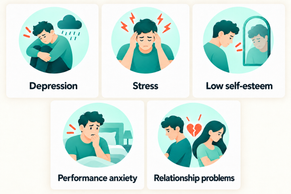
Depression
Depression is an increasingly common mental health condition. It affects people of all ages.
The pandemic made things worse. The depression rate in June 2020 was double the pre-lockdown rate. People affected by depression during the pandemic were also twice as likely to say their relationship had been impacted, compared with those who had no or only mild depressive symptoms.1
Activities they once enjoyed can stop bringing pleasure, so they withdraw from them. Sex is often one of them. Depression tends to lower libido, so the urge to have sex becomes rare, and that can make it harder to get an erection, even with stimulation that would normally be arousing.
On top of this, common antidepressants like SSRIs and SNRIs are known to lower libido. They could be a direct contributor to ED.
Do not stop your antidepressant because of ED. Speak to your GP about your options first.
Stress
When there's a lot to manage in life, sex is often one of the first things to take a back seat. Stress keeps your mind occupied elsewhere. It can also disrupt your hormone levels and narrow your arteries, restricting blood flow to the penis.
Post-traumatic stress can have an even bigger impact. One study found that PTSD increased veterans' risk of sexual dysfunction by more than three times.2
Stress affects your body as well as your mind, which is why it's such a common trigger for ED.
Personal and professional stress is one of the main causes of ED in middle-aged men. Job problems, relationship issues, financial pressure, or a change in health can all play a part too.
Low self-esteem
Low self-esteem is often rooted in a negative body image. But it doesn't have to be about physical appearance.
A difficult break-up, childhood bullying or a traumatic life event can damage self-worth, leading to lower confidence and a real toll on wellbeing.
That low self-esteem can carry over into the bedroom. Fear and anxiety about being "good enough" can make it hard to stay relaxed and can lead to erection problems. Negative body image also commonly reduces desire for sex.
Prolonged self-esteem issues can lead to depression, anxiety, and self-medication. All three are linked to low libido.
Performance anxiety tends to feed on itself, with each setback adding pressure next time.
Nervousness about how you'll perform in the bedroom can happen at any age. But it's most common as a teenager or young adult, when you're first starting to have sex.
It's not unusual for this to continue, or to resurface later in life, especially if you haven't been sexually active for a while. Low self-esteem and general anxiety can feed into it. A 2015 study found a close connection between performance anxiety and depression.3
The tricky part is that the pattern often becomes cyclical. One difficult experience knocks your confidence. That increases the anxiety going into the next encounter, which causes the erection problems to repeat.
Relationship problems
Any issues in a relationship can lower your desire for sex with that person.
Becoming more preoccupied with work, or taking on extra responsibilities like caring for children or ageing parents, can bring stress that spills into the bedroom. Less time together can start to break down communication.
For newer couples, more frequent arguments can have the same effect, making you less interested in sex. Whatever your situation, damage to the connection with your partner tends to lower your arousal around them, and that increases the likelihood of ED.
Pornography addiction
Porn can be a useful tool for exploring your sexuality with a partner and trying new things. But it's free and instantly available, so it's never been easier to watch too much.
It's less about porn itself and more about how much, and how early, it's watched.
Content has become more extreme and overtly sexual compared to a few decades ago. Watching porn frequently can train your brain to expect a similar level of stimulation before arousel, which can set unrealistic expectations about sex and sexual partners in real life.
A study of 28,000 Italian men found that those who watched large amounts of porn from an early age often became desensitised to it. They were more likely to lose interest in real-life sexual encounters, something the researchers called "sexual anorexia".4
The likely result of this over-stimulation and desensitisation is the inability to get or stay aroused by a partner during sex. This can lead to a diagnosis of pornography-induced erectile dysfunction (PIED).
How can you treat psychological erectile dysfunction?
It's vital to address the root psychological causes of your ED, but a combination of behavioural and medicinal treatments works best.
ED treatments
There are several erectile dysfunction treatments that have been clinically proven to improve sexual function. Popular oral medication includes:
- Viagra/Sildenafil - Viagra is the branded name for generic sildenafil, a PDE5 inhibitor that relaxes the blood vessels in your penis to allow enough blood flow when you're sexually stimulated.
- Cialis/Tadalafil - Cialis is the branded name for generic tadalafil. It works in largely the same way as sildenafil, but takes effect in half the time (15-30 minutes), and also comes as a daily tablet so you can have sex spontaneously.
- Levitra/Vardenafil - Levitra is the branded name for generic vardenafil, another PDE5 inhibitor. This treatment is most suitable if you have diabetes.
Alternative treatments include:
- VaxAid Deluxe - a hydrotherapy vacuum pump system that uses pressure to encourage blood flow to the penis. It's one of the most powerful options available while still being safe, achieving the maximum negative pressure the MHRA recommends in a controlled way.
Change your medication
If you're taking medication for depression and you're experiencing ED or a drop in libido, ask your GP to talk you through your options. SSRIs and SNRIs are known to reduce libido, but NDRIs like Wellbutrin do not have this effect. Do not adjust your dose or switch medication without speaking to your GP first.
Therapy
An outside perspective can offer insight into how your mind works. It can help identify patterns of behaviour and break a negative cycle using structured steps. Types of therapy include:
- Counselling - a therapist works with you to identify your stressors and your triggers for anxiety or depression, and shows you ways to manage them.
- Psychodynamic therapy - this digs into your subconscious to identify any deep internal conflict that's the root cause of your ED.
- Sex therapy - this aims to reduce stress and anxiety around sex by focusing on sensation and pleasure, rather than arousal and performance, to help you build a secure and reliable sex life.
- Sexual anxiety therapy - this focuses on reducing anxiety by improving your understanding of ED: the causes, any underlying emotional issues, and the solutions.
Stress management techniques
Small daily habits, like exercise, music and meditation, can all help bring stress levels down.
There are plenty of techniques to identify your stress triggers and manage the negative feelings that follow.
Experts have found that slow-tempo, instrumental songs, whatever genre you prefer, are the best music for unwinding and decompressing.5 Exercise is vital for stress relief, releasing endorphins that create positive emotions and help combat stress, anxiety, and depression.
Meditation is another proven stress-reducer, giving your mind space to clear and refresh. Guided imagery is one type worth trying to help boost libido: you write a script describing a successful sex session with a partner, record yourself reading it aloud, then play it back while you visualise the experience.
When should you seek medical advice?
If ED is linked to how you're feeling, your GP can help with both, not just the physical side.
Speak to your GP if:
- Low mood, stress, or anxiety are affecting your daily life, not just your sex life
- ED continues despite addressing the psychological factors above
- You're relying on pornography in a way that feels out of your control
- You have thoughts of harming yourself, or you're finding it hard to cope
Do not stop or change antidepressant medication without medical advice, even if you suspect it is contributing to your ED. If you need urgent support, contact NHS 111, Samaritans on 116 123, or your GP surgery.
Frequently asked questions
Can stress cause erectile dysfunction?
Yes. Stress can disrupt your hormone levels and narrow the arteries that supply blood to the penis, making it harder to get or keep an erection. It's one of the most common psychological causes of ED, especially alongside job pressure, financial worries, or relationship problems.
How do I know if my ED is psychological or physical?
Getting erections in your sleep or when masturbating, but struggling during sex with a partner, can point to a psychological cause. A GP or prescriber can help you work out the cause and recommend the right treatment.
Can antidepressants cause erectile dysfunction?
Yes, some can. SSRIs and SNRIs are known to lower libido, while NDRIs such as Wellbutrin do not tend to have this effect. Do not stop or change your antidepressant without speaking to your doctor first, as they can advise on the safest way to adjust your treatment.
Does watching porn cause erectile dysfunction?
Frequent, heavy porn use has been linked to desensitisation and difficulty getting aroused by a partner, sometimes called pornography-induced erectile dysfunction (PIED). Not everyone who watches porn experiences this, but cutting back may help if you're finding it hard to get aroused without it.
Can psychological erectile dysfunction be treated?
In most cases, yes. A combination of therapy, stress management, and, where appropriate, ED medication can help. Addressing the root cause, whether that's stress, low self-esteem, or a relationship issue, tends to give the best long-term results.
When should I see a GP about erectile dysfunction?
See your GP if ED is ongoing, if low mood or anxiety are affecting more than your sex life, or if you think a medication you're taking might be the cause. Contact your GP or NHS 111 urgently if you're having thoughts of harming yourself.
References
- Office for National Statistics. Coronavirus and depression in adults, Great Britain: June 2020. ONS; 2020. ons.gov.uk
- Breyer BN, et al. Sexual Dysfunction in Male Iraq and Afghanistan War Veterans: Association with Posttraumatic Stress Disorder and Other Combat-Related Mental Health Disorders: A Population-Based Cohort Study. The Journal of Sexual Medicine. 2013. onlinelibrary.wiley.com
- Rajkumar RP, Kumaran AK. Depression and anxiety in men with sexual dysfunction: a retrospective study. Comprehensive Psychiatry. 2015. pubmed.ncbi.nlm.nih.gov
- Ansa.it. Italian men suffer 'sexual anorexia' after Internet porn use. Ansa; 2011. ansa.it
- Jiang J, Rickson D, Jiang C. The mechanism of music for reducing psychological stress: Music preference as a mediator. The Arts in Psychotherapy. 2016. sciencedirect.com
This article is intended for informational purposes only and does not replace professional medical advice. Always read the patient information leaflet supplied with your medication and speak to a healthcare professional if you have specific concerns.